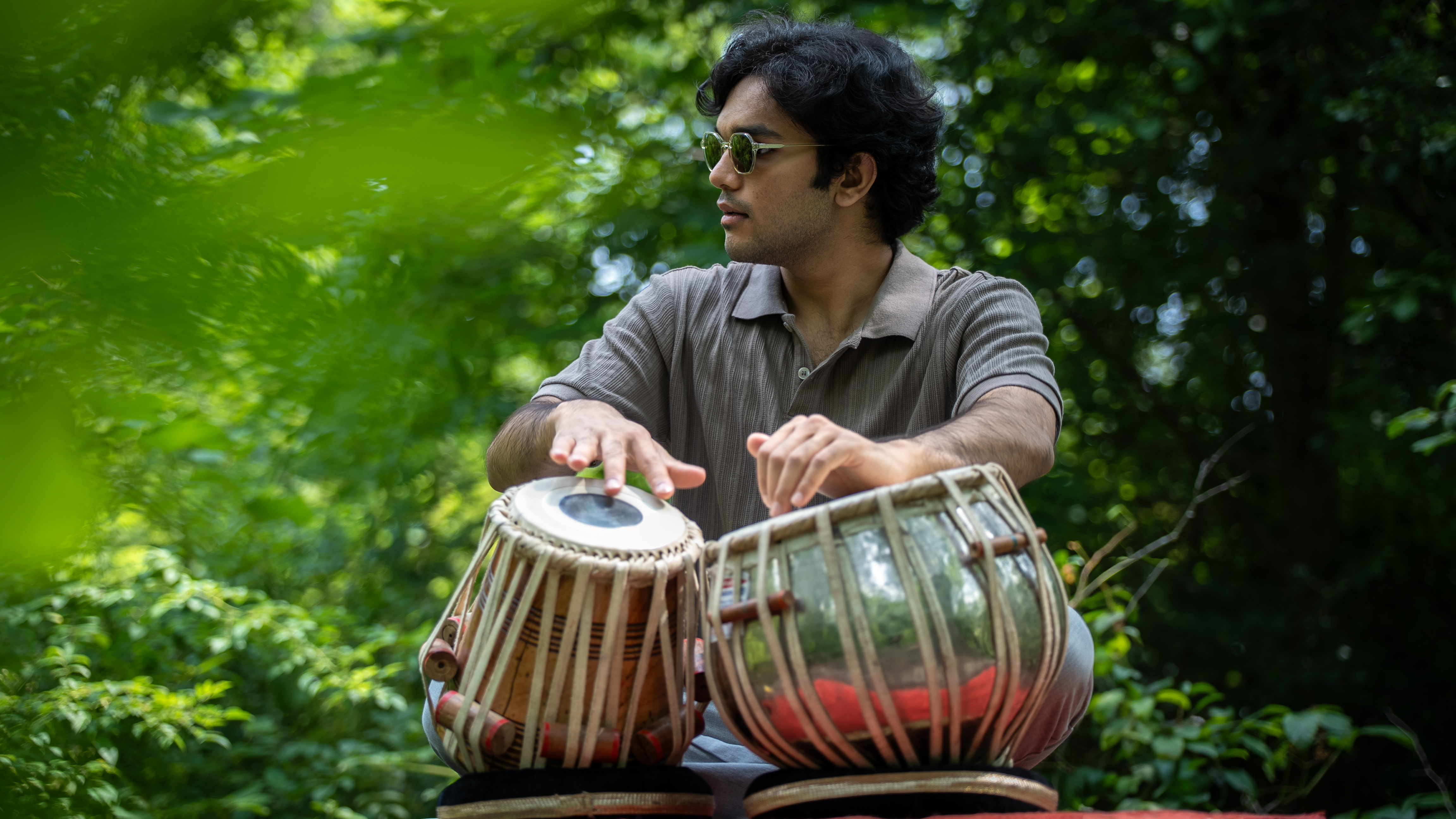
Vivek Pandya’s latest release, "The Tabla Cypher," proves that tradition and innovation don’t have to sit on opposite ends of the stage. Instead, they can collide in real time, as Pandya shows by taking the centuries-old language of tabla and thrusting it into an improvisational experiment that challenges expectations of rhythm, mood, and control.
For Pandya, this track was never about playing it safe. “I wanted it to be a little aggressive rhythm. Not a calm mood, kind of an aggressive mood. But more than even the mood, this was just an experiment,” he explains. Recorded in a single take, "The Tabla Cypher" captures raw immediacy. “I wanted it super aggressive and to display the language of the instrument. It was completely improvisational, just playing what was on my mind. My main focus was making the beat and the instrument cohesive.”
That cohesion does not come by accident. Pandya has been trained in the oral tradition of Indian classical percussion, where adaptability is second nature. “As classically trained musicians, we adapt easily because our music isn’t written on sheet music, it’s an oral tradition. We learn by experience, by improvisation. That allows us to transpose knowledge into any genre, like Ravi Shankar with The Beatles or Zakir Hussain with John McLaughlin and Shakti. It’s like a language, abstract, but with phrasing and emotion.”
Improvisation, though, does not mean carelessness. In fact, Pandya insists that mistakes are more about response than error. “Messing up can mean different things. In orchestral music, it’s the wrong note. Here, improvisation allows for mistakes. If you don’t know how to correct them, that’s a true mess-up. So, first, it’s about how well your brain can think on the spot, and second, how well your hands can transpose those thoughts. If they can’t align, that’s when you’ve really messed up.”
In "The Tabla Cypher," he spotlights rhythmic complexities rather than virtuoso flourishes. “Groove patterns and polyrhythms. For example, playing 5 against 4, or 4 against 7. I matched groove patterns to the beat but gave space for the melody to shine. I wasn’t focused on tabla technique; I’ve already mastered that. I’m focused on impact. If the music impacts you, it’s successful.”
His mastery comes from years of training under legendary tabla maestro Pt. Anindo Chatterjee. “Without him, I wouldn’t be where I am. I had one-on-one private lessons, three hours focused on me. It built not just my technical skill but my musical mind. Early on, it was heavy on technique, but as I grew, it shifted into guidance and insights. I’m lucky to learn under one of the greatest of all time.”
Despite his classical roots, Pandya does not shy away from contemporary experimentation or unconventional stages. “Tradition isn’t about never experimenting. I’ve played 95 classical shows, but to reach wider audiences today, sometimes you play in clubs or unconventional venues. There’s no big patronage system anymore, so we have to make it accessible. I don’t worry about violating tradition because I’ve studied and respected it. Once you know it deeply, you can innovate.”
Already gracing iconic stages like Lincoln Center in New York, with a Barbican debut in London on the horizon, Pandya sees success not only in personal milestones but in building sustainable futures for the art. “My dream is to build a patronage system or organization to support this art form with big concerts worldwide. That’s how we keep the tradition alive while sustaining ourselves as musicians.”
With "The Tabla Cypher," Vivek Pandya shows how a single take of improvisation can echo centuries of heritage while carving new space for the future of tabla. It’s more than a rhythm, it’s a declaration that tradition and experimentation are two sides of the same beat.
Socials