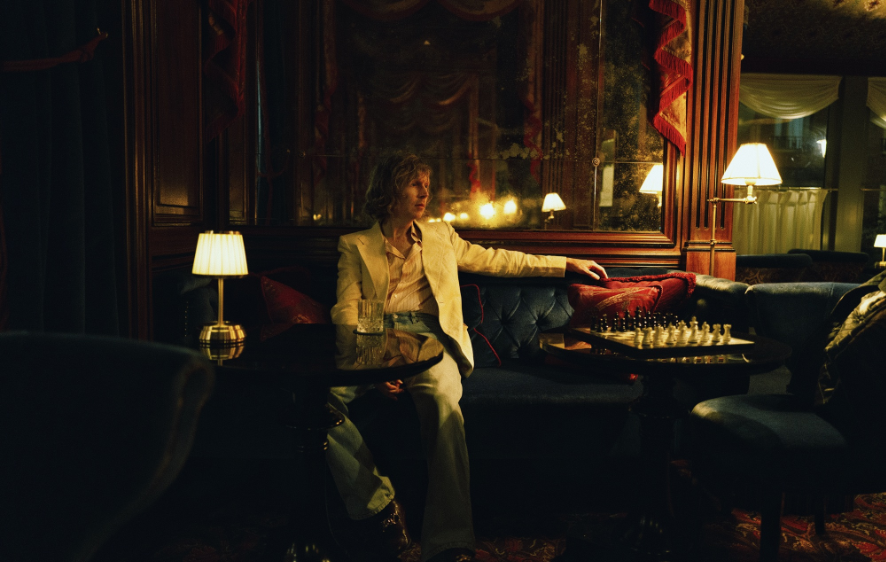
With its imagery-rich writing, dreamy atmospheres, and offbeat pop style, the London artist’s latest release feels like the perfect soundtrack for A24’s next move into music.
Sometimes at night, when Mark William Lewis feels overwhelmed, he heads to the banks of the Thames River and skips rocks across the water. “Each stone,” he says, “is another thought sent spinning into the water.” It is a powerful ritual, one you can almost hear in his shadowy, introspective guitar ballads. In his dusky baritone, he meditates on heartbreak, connection, and the weight of existence. Fragments of ideas and fleeting images drift through his delicate songs; elusive truths appear briefly before sinking back into the dark.
On his new self-titled album, the first non-film release on A24’s music imprint, he continues to lean into that approach. The record’s 12 tracks feel fragmented, restless, and unsettled, held together only by Lewis’ steady voice. From the opening notes of “Still Above,” he sounds pensive and unsure, asking for peace, turning over old memories, and reflecting on a “restless journey home.” Surrounded by gasping horns and echoing electric guitar lines that recall a Blue Nile record played at the wrong speed, he appears as a solitary figure, moving through a world that feels just out of reach.
The atmosphere across the album is uneasy and tense. Even “Tomorrow Is Perfect,” which is breezier compared to most of his work, carries a nervous energy as he quietly sings about fanged hounds, unfriendly doctors, and “the brutal bridge of betrayal.”
On “Spit,” Lewis paints grim images of illness, regret, and “blood in your spit every fucking day.” The distorted and alien-sounding “Brain” is framed as an attempt at reconciliation, though even in those moments, his pleas are shadowed by doubt and mistrust. His lyrics are intentionally slippery, more suggestive than direct, but together they conjure a heavy and unrelenting headspace. Still, the songs never collapse entirely into despair. “Still Above,” though unhurried, experiments with glimmers of sophistipop. “Seventeen” is heavy with longing and sadness, but its gentle acoustic strums echo the softer side of Alex G’s ballads. And through it all, Lewis’ voice remains a constant—low, restrained, and soothing—bringing a sense of calm to even the darkest passages.
In many ways, Lewis is still working in the same style he developed coming out of London’s experimental scene, one that also produced peers like Bar Italia, Double Virgo, and Still House Plants. Like them, and like a long lineage of UK pop outsiders from Talk Talk to Bark Psychosis to Dean Blunt, he borrows from rock and folk traditions but twists them into unexpected forms. His harmonica, which drifts across several tracks on Mark William Lewis, nods to his father’s love of Bob Dylan and Neil Young. Still, even that familiar sound is reshaped in unfamiliar ways. Catharsis and soaring choruses are nowhere to be found, even though Lewis himself has challenged the avant-garde scene he came from to embrace them. “Just give me a chorus, please,” he told The Fader. “Take a risk and don’t be afraid to say something revealing about how you feel.”
Ironically, his own songs rarely give in to that demand, and that restraint is what makes them so compelling. The music is charged with emotion, but never spills into straightforward vulnerability. The details that drive these songs are obscured, blurred around the edges, yet clearly meaningful. Each cryptic phrase is balanced by spiraling guitar lines or fragile instrumental textures that gasp for air. The silences, the fragments, the hesitant breaks between words—all of them gesture toward bigger ideas and nearly tangible truths. Listen closely, and entire worlds open up in every pause.


.png)